
 1 month ago
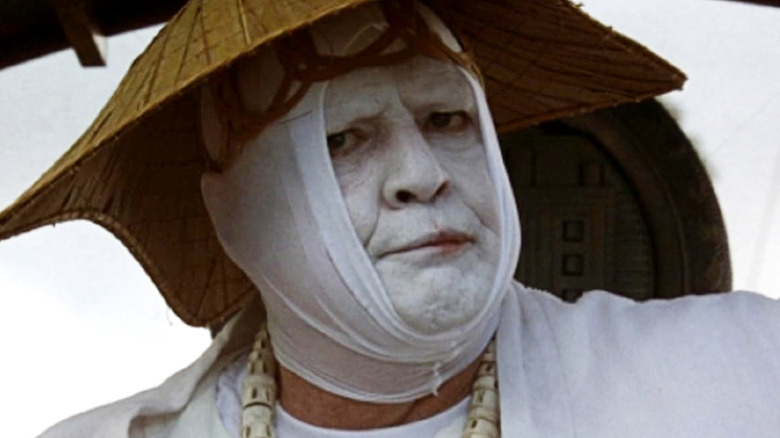
New Line Cinema
Some movies are flat-out cursed. Take Dick Powell's Ghengis Khan epic "The Conqueror" for instance. It was shot on location in Utah in 1955, downwind of a nuclear testing site. By 1980, 91 of the 220-member crew had been diagnosed with cancer. Also, the film is flat-out awful, with John Wayne embarrassing himself in yellowface as the Mongol warlord. Add in that it fell well short of recouping its $6 million budget, and you can't make a bigger disaster than that.
Not that New Line Cinema didn't try its damndest with 1996's "The Island of Dr. Moreau." Based on H.G. Wells' novel of the same title, which had formed the basis for four previous features, it was a strange gamble for the studio. They were intrigued by writer-director Richard Stanley, who'd made the visually striking sci-fi horror film "Hardware" and the hallucinogenic horror-western "Dust Devil." Neither film set the box office on fire, but New Line was a studio renowned for taking risks on commercially unproven directors like David Fincher ("Seven"), Bill Duke ("Deep Cover"), and the Hughes Brothers (Menace II Society). So they pulled the trigger — and, boy, did that shot backfire.
Where to begin? Stanley and New Line were at odds early in pre-production, and that relationship rapidly deteriorated. New Line insisted on Marlon Brando as the mad Moreau, who creates animal-human hybrids via surgery, thus saddling Stanley, who was directing his first studio movie, with one of the most notoriously meddlesome stars in film history. The short version: Stanley got fired, and the film, which was finished by John Frankenheimer, grossed just $60 million globally against a $40 million budget. But there is so much more to this story.
The Island of Dr. Moreau was inadvertently designed to fail
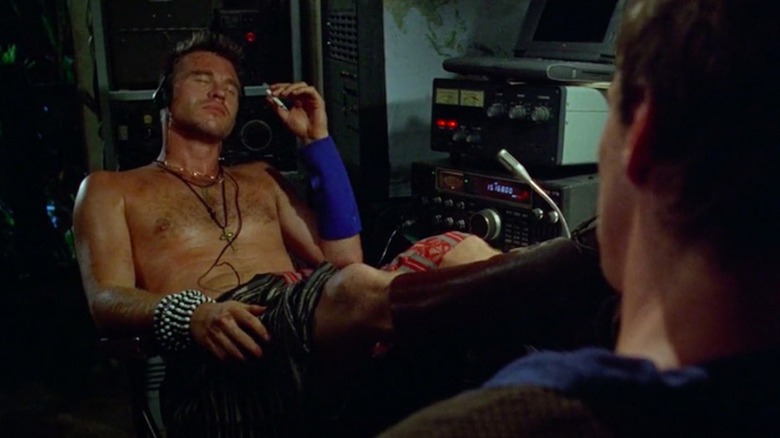
New Line Cinema
Though it's heavily slanted toward Stanley's version of events, I recommend checking out the documentary "Lost Soul: The Doomed Journey of Richard Stanley's 'Island of Dr. Moreau.'" You get a fine sense of why he was driven to make the movie, and how his creative temperament doomed him from the start. It should, however, be noted that, since the documentary's release, three women have accused Stanley of domestic violence, so maybe you don't need this in your life. These allegations certainly destroyed his attempt to cultivate a maverick underdog image, which is a good thing.
Had all gone according to plan, Stanley would've cast Jürgen Prochnow as Moreau, Bruce Willis as United Nations agent Edward Douglas and James Woods as Moreau's medical assistant Dr. Montgomery. After meeting and bonding with Brando, Stanley had an important voice in his corner. He did not receive the same cooperation from Val Kilmer, who was initially hired to replace Willis, but shifted to the role of Montgomery because he wanted to work fewer days. Rob Morrow stepped up to play Douglas, but he departed the project after the second day of shooting due to the hostile environment.
Stanley lasted one more day than Morrow. He'd completely lost New Line's trust, and was replaced with the great John Frankenheimer ("The Manchurian Candidate," "Seconds"). Alas, Frankenheimer proved too much the taskmaster, and allegedly burned his crew. Meanwhile, Brando and Kilmer were oil and water. They cost the production days by playing a petulant game of trailer chicken, but at least Brando's act was predictable. Kilmer? He repeatedly went off-script and, at one point (maybe accidentally), burned a cameraman with a cigarette. Overall, it was a hellish shoot.
Frankenheimer's The Island of Dr. Moreau is a misbegotten genre hybrid
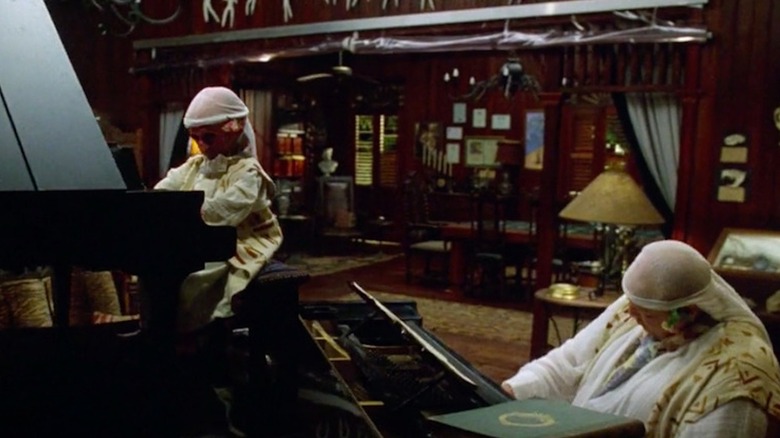
New Line
The best that can be said about "The Island of Dr. Moreau" is that no one died of radiation-induced cancer (that we know of). Frankenheimer's film is interesting in an autopsy sense. It's a corpse ridden with numerous maladies.
The blame for this cinematic debacle is shared: New Line should've never given the erratic Stanley a studio film; Stanley should've been more cooperative with the studio that gave him the chance to make a dream project (he reportedly skipped out on meetings, and was generally inflexible); and they should've passed on Brando because Willis was more than enough of a star in 1996 to carry the movie (so keep Prochnow). Instead, New Line made disastrous decisions all the way down the line. But, hey, at least we got Nelson de la Rosa as Brando's diminutive sidekick, Majai, who was the inspiration for Mini-Me in the Austin Powers franchise.
This failure lit a fire under Frankenheimer. Two years later, he roared back to action-filmmaking form with the spectacular "Ronin." Stanley, on the other hand, disappeared. He briefly resurfaced with a pretty good adaptation of H.P. Lovecraft's "Color Out of Space" starring Nicolas Cage, and then the allegations hit. He wrote and will appear in the upcoming "Winnie-the-Pooh: Blood and Honey 3."
There are three other significant film versions of "The Island of Dr. Moreau," the best by far being Erle C. Kenton's "Island of Lost Souls" starring Charles Laughton, Bela Lugosi and Kathleen Burke as Lota, the Panther Woman. It's considered one of the great sci-fi/horror films of the 1930s, and, thus far, the definitive adaptation of the novel. Ironically, Wells hated it.






 English (US) ·
  Indonesian (ID) ·