
 4 months ago
Paramount
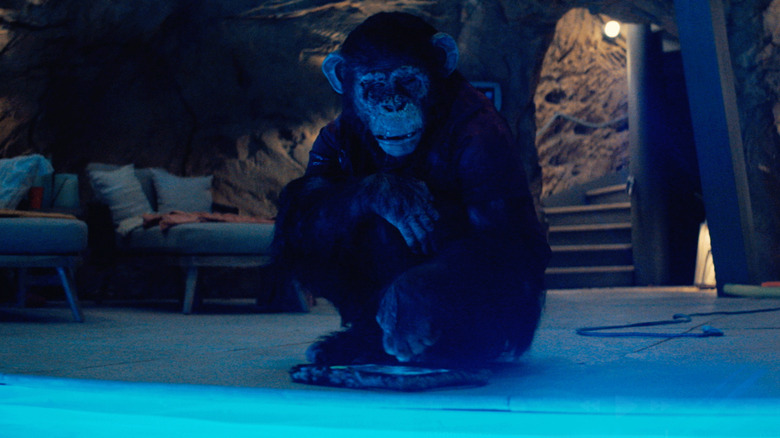
Johannes Roberts' killer chimpanzee movie "Primate," currently on Paramount+, is just as goofy as one might expect. It's a night of bloody ape mayhem, and little else. The plot involves a chimpanzee named Ben (Miguel Torres Umba), living with a gentle family of primatologists in Hawai'i, who contracts rabies from a rogue mongoose and goes feral during a house party. Ben savages a gaggle of twentysomethings who do increasingly ill-advised things to avoid him. It's a slasher movie with a rabid primate. Macaque-l Myers? I'll workshop that pun.
Chimpanzees are, of course, notoriously violent animals. There's a reason why the chimps you see in movies are always so small. It's because young chimps are relatively docile. Adult male chimps can stand about 4'11". When was the last time you saw a chimpanzee the size of Sabrina Carpenter in a movie? Yeah, those chimps cannot be tamed. You may have seen old Tarzan movies as a kid, and loved the idea of cuddling up to Cheetah the chimpanzee, but know that each one of the Cheetah chimps either died or retired at an early age. Showbiz is rough.
Of course, thanks to the success of Merian C. Cooper and Ernest B. Schoedsack's "King Kong" in 1933, killer apes and monkeys, especially giant ones, have become staples of world cinema. Killer apes stand as a reminder that, evolutionarily, we haven't come very far. In many ways, we are King Kong. We are Ben the chimp. We are Cheetah. We are every single one of our ape and monkey siblings. It also helps that gorillas and apes can often be played by human actors in goofy-looking fur suits; unrealistic gorilla costumes are a kitsch tradition as old as time.
The following movies will, then, give you your ape fix. Take a look.
King Kong Escapes (1967)
Toho
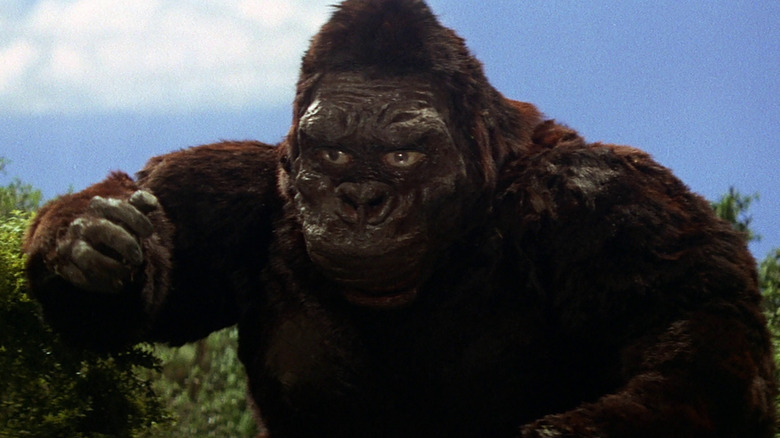
Ishiro Honda's 1967 film "King Kong Escapes" is a curious live-action spinoff of the 1966 Toei animated series "The King Kong Show." It follows King Kong (Haruo Nakajima), but spins into wild sci-fi territory with the introduction of Mechani-Kong (Hiroshi Sekita), a robotic duplicate of the great ape lord. Mechani-Kong has been built by the wicked Dr. Who (Hideyo Amamoto), carried over from the animated series, to dig for a rare element, Element X, which exists only beneath the polar ice cap. When Mechani-Kong shuts down during the job, Dr. Who figures he can kidnap the real King Kong and hypnotize him to finish the gig. Seems like Dr. Who should have started with that plan.
Mie Hama plays the evil Madame Piranha, while Linda Jo Miller plays Susan, the woman Kong will become enamored with. Eventually, Kong and Mechani-Kong will fight, natch. It'll be awesome.
Japanese kaiju films are among the best movies ever made. Honda and his contemporaries understand what cinema is supposed to be used for: monstrous spectacle derived from the human subconscious. Movies like "King Kong Escapes" understand that there is an eight-year-old inside each of us that wants to see cinematic legends like King Kong fight robots. King Kong scares us, but we also love him.
It's been noted by many critics — and was even noted in the movie "Inglourious Basterds" — that "King Kong" is a metaphor for a 19th-century-era Black person being kidnapped from their home country in Africa and brought to the United States to be forced into slavery. Movies like "King Kong Escapes" eschew that legacy for wild entertainment in which King Kong is a heroic fighter, destroying the whims of ambitious billionaires. It's pretty great.
A*P*E (1976)
Worldwide Entertainment
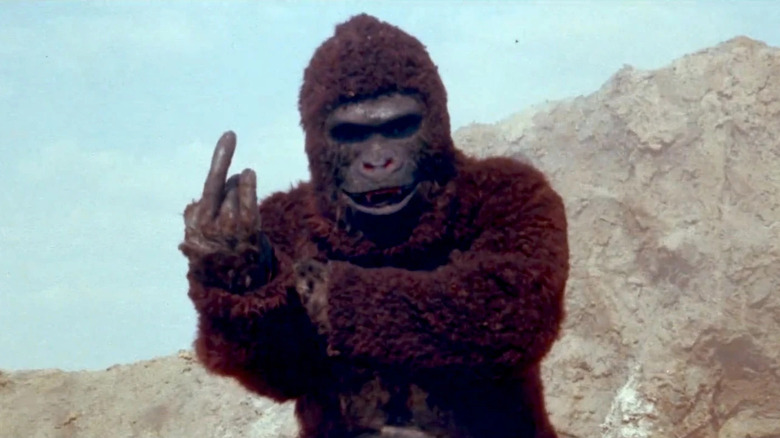
The Korean kaiju film "A*P*E" is, it should be noted right away, cheap and awful. It was shot in 3D and features prolonged, nonsensical scenes of the movie's central Ape (Park Kwang Nam) fighting rubber sharks, giant snakes, and eventually, the military. The Ape is supposed to be a giant like King Kong, but never looks like anything other than a guy in a fur suit. Joanna Kerns plays an American actress named Marilyn whose locally shot movie is interrupted by the Ape's inevitable rampage. The Podcast on Fire Network noted that "A*P*E" had a budget of only $23,000, and even then, you wonder where the money went. It's a clunky, bad, cheap-looking ape movie that is only well-suited to heavy drinking after hours.
But it is VERY well-suited to heavy drinking after hours. It's the kind of bad movie that is immensely entertaining. Viewers will, I assure you, not give a damn about Marilyn, her movie, or her tepid romance with the insipid Tom (Rod Arrants). What they will take away is that the Ape is a nasty, angry customer who flips off his attackers. That's pretty awesome.
On the back of the "A*P*E" video box, it's explained that the letters in the title are an acronym for "Attacking Primate monstEr." It's hard to tell from watching the movie itself, but "A*P*E" might actually be a very arch, low-budget spoof on King Kong movies and other monster flicks of the day. This would explain why the Ape tears apart a fake-looking shark. It's literally destroying "Jaws."
Monkey Shines (1988)
Orion Pictures
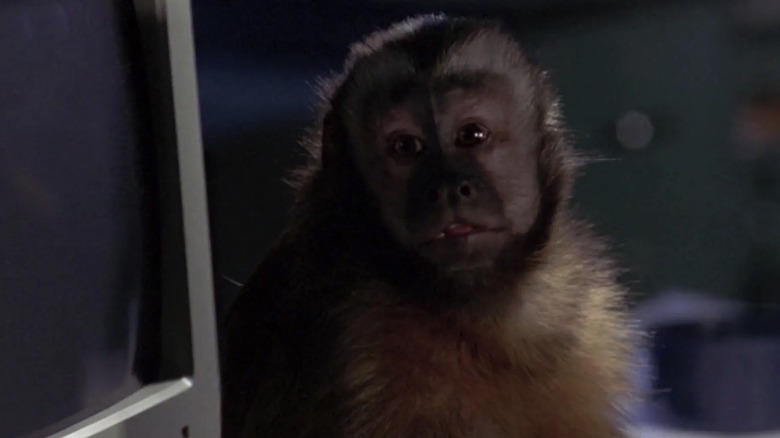
A genuinely terrifying flick, George A. Romero's "Monkey Shines" will make you suspicious of capuchin monkeys. Jason Beghe plays a former athlete named Allan who is hit by a truck and left paralyzed from the neck down. Adjusting to his new life proves difficult, and he doesn't seem to be receiving much encouragement from his unkind mother (Joyce Van Patten). He is eventually made aware of the phenomenon of trained helper monkeys, who can retrieve items for disabled people and help with monkey-sized tasks around the house. Allan hires such a monkey, Ella (Boo the monkey), and everything seems to work out. Well, at first.
Ella and Allan get along swimmingly. Indeed, they grow so close that Allan believes that Ella can almost read his mind. Allan also begins having dreams where he sees the world through Ella's eyes, leading him to consider that they may be psychically linked. This becomes a problem, however, when Allan begins dating the pretty Melanie (Kate McNeil). Ella, it seems, becomes jealous, perhaps to a murderous degree. Ella also begins going after the people who wronged Allan. It's amazing how many ways a little capuchin monkey could potentially take out a human being.
"Monkey Shines" also has a great jump scare right at the end, although, according to the book "The Cinema of George A. Romero: Knight of the Living Dead," that ending was tacked on by the studio without Romero's knowledge. It has nothing to do with the plot, but it will still stick in your memory. "Monkey Shines" stands out for the seriousness with which Romero takes the material. Although it's about a killer monkey, it's never anything less than a whole psychological thriller.
We ranked it ninth out of Romero's filmography.
Shakma (1990)
Castle Hill Productions
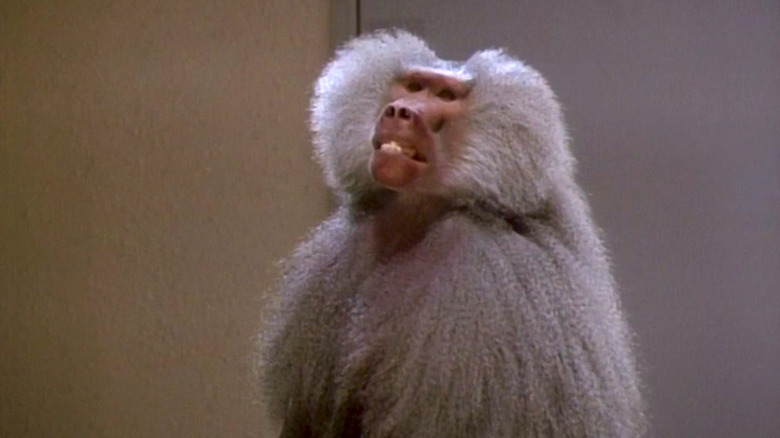
I love Hugh Parks' and Tom Logan's 1990 animal attack movie "Shakma" more than is reasonable. It certainly contains some of the finest examples of animal wrangling I have ever seen in a movie, as the central baboon (Typhoon the baboon) seems to be genuinely full of rage. Baboons are pretty aggressive animals as is, so getting one to flip out on the safety of a film set seemed like a difficult task. Many actors in "Shakma" ran through doors, only to have a baboon slam into said doors right behind them. I was once personally told at a screening of "Shakma" — and this hasn't been substantiated — that Typhoon attacked doors with such aggression because there was a female baboon in heat on the other side. Typhoon wasn't angry. He was horny.
The premise of "Shakma" is wild. A bunch of medical students (including David Naughton, Amanda Wyss, and Rob Morris) and their instructor (Roddy McDowell) have locked themselves into a medical tower for the night to LARP a campaign in a "Dungeons & Dragons"-style role-playing game. McDowell gives wizardly directions via the building's intercom. Shakma was meant to be euthanized earlier that day in the same building, as the baboon had been injected with an experimental steroid that left him crazed. Shakma, however, awakens and begins stalking the LARPers around the hospital.
Is this a silly premise? Perhaps. But "Shakma" locks into place surprisingly well. It might help that Typhoon is genuinely terrifying. The odd role-playing game premise makes "Shakma" unique, setting it apart from other animal-attack movies. It's better than it has any right to be.
The Monkey (2025)
Neon
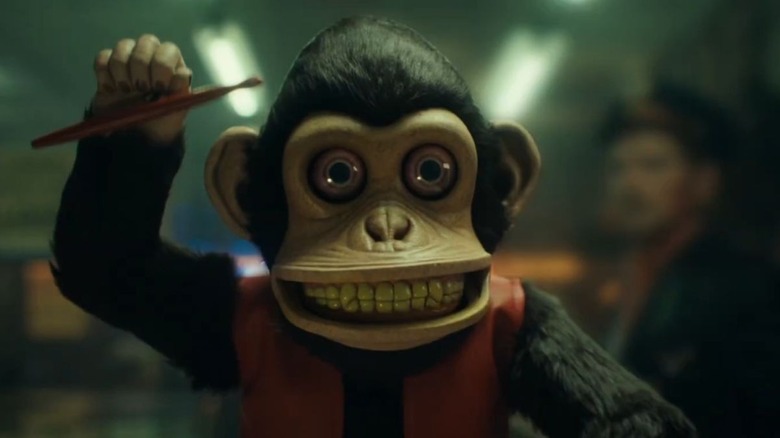
Osgood Perkins' 2025 film "The Monkey" doesn't have a monkey in it, but it does have a cursed monkey toy that kills. The titular primate is a three-foot-tall, very elaborate wind-up drumming monkey toy with wide, scary eyes and a spooky frozen grin. When you wind it up, it drums for a few moments, with eerie music emanating from somewhere deep in its abdomen. Then, without explanation, someone in the vicinity, cursed at random, will die a horrible death.
The main characters of "The Monkey" are twin brothers Hal and Bill (both played by Theo James), who had horrible run-ins with the monkey in their youth — it likely killed their depressive mother (Tatiana Maslany) — and have to contend with its reappearance many years later. It's never explained why the monkey has the power to randomly take lives, but we do know how it operates: it never kills the person who wound it up, and it doesn't take requests.
One will remember "The Monkey" for how delightfully nasty it is. The film has a very bleak sense of humor and is knowingly cruel to its characters. If the movie had a mouth, it would sport the wicked grin of a disturbed teen pulling the wings off of flies. Adam Scott has a cameo at the beginning of the movie, and he states the thesis up front. "We are all f***ed to hell," he says. And that's where "The Monkey" lives. What a fun movie. /Film gave the film a middling review, but a revisit clarifies the movie's overall cynicism.
A filmmaker named Spencer Sherry also made a short version of "The Monkey" prior to Perkins, and everyone should be made aware of it.


 English (US) ·
  Indonesian (ID) ·