
 1 month ago
Disney
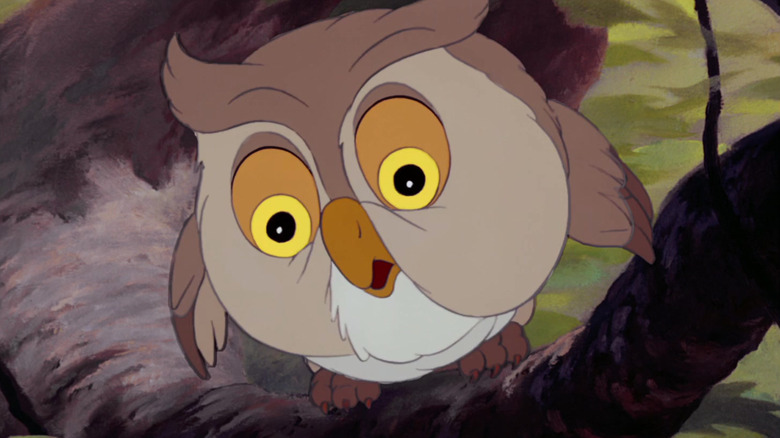
Nobody does heartbreaking deaths quite like Disney, a tradition that goes back all the way to 1942's "Bambi." A loose adaptation of Felix Salten's 1923 novel "Bambi, a Life in the Woods," it was the studio's first animated film to be devoid of any significant human characters. Even Disney's 1940 box office bomb turned cultural touchstone "Fantasia" had Mickey Mouse's stern mentor in the "Sorcerer's Apprentice" segment. In "Bambi," however, humanity is represented solely in the nebulous form of a hunter who never fully appears on-screen and is referred to by the movie's animals as the bringer of death and destruction known as "Man."
84 years after its wide theatrical debut on August 21, 1942, there's still something audacious about the way "Bambi" tells its story through the eyes of the critters inhabiting a vast and almost mythical forest. You can see how it blazed a trail for modern animated classics like "The Wild Robot" and the Oscar-winning "Flow." Yet, as much as the movie unfolds as an environmental parable, at its core, it's a coming of age tale that follows its namesake — a white-tailed deer voiced by Bobby Stewart, Hardie Albright, and John Sutherland at different ages — and his friends as they grow up, learning about life, love, and everything in-between.
Oh, and mortality. The scene where Bambi's loving mother (Paula Winslowe) is shot and killed by "Man" has burned itself into the psyches of multiple generations who first saw the movie as children. (If you can believe it, though, Japan's answer to "Bambi" with the short "Ringing Bell" was even darker.) The film's influence can be felt far and wide, from the animation landscape to the horror works of Stephen King. That's not bad for a movie that was initially seen as a commercial disappointment.
Bambi wasn't initially the hit that Disney had hoped for
Disney
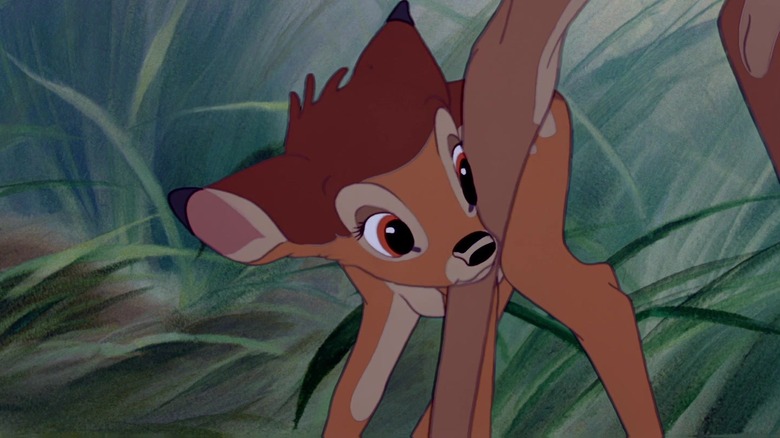
"Bambi" was the first Disney animated feature to hit theaters after the U.S. had entered World War II, although the Mouse House had already begun to feel the effects of the conflict prior to that. As noted by Smithsonian Magazine, "Fantasia," "Bambi," and Disney's original animated "Pinocchio" (which reached theaters nine months before "Fantasia") "all logged early box office losses upon their release" due to the international market having shrunk amidst the ongoing war. This was all the more of a issue when it came to "Bambi," as Walt Disney and his creative collaborators had invested a whole lot of time, money, and resources into making it a reality.
Per AFI, contemporary sources have reported that "Bambi" entered pre-production as far back as 1936 and was once meant to be Disney's second animated feature after 1937's "Snow White and the Seven Dwarfs." Why the delay? Various economic and labor-related issues have been cited by historians, but it was also largely because Disney himself had wanted the movie to look more realistic than anything the studio had made before. His animators' efforts weren't in vain, either, as the film's animals are much more true to life in terms of their anatomy and how they move compared to their peers in Disney's previous animated pictures. That's to say nothing of the movie's harrowing climax, in which Bambi's home is reduced to ash and smoke by a horrific and visually authentic wildfire.
Produced for roughly $2 million (which was more than what "Snow White" cost but less than the budget for "Pinocchio"), "Bambi" eventually turned a profit thanks to its theatrical re-releases in the years following the conclusion of WWII. All the same, it has a somewhat complicated legacy today.
There's a reason Disney hasn't remade Bambi (yet)
Disney
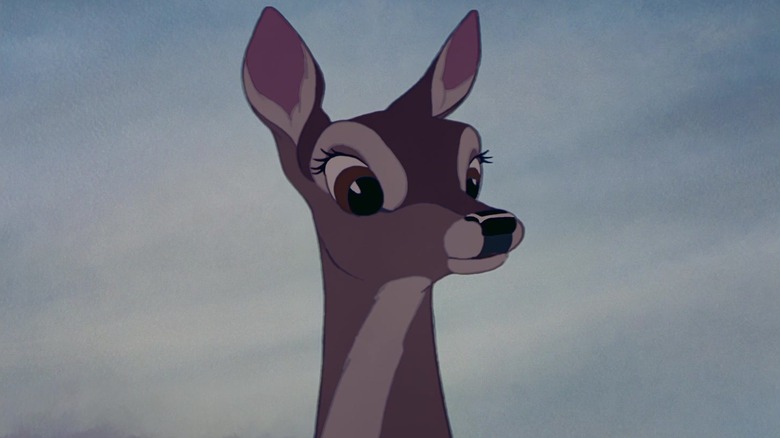
Given its unmistakable vilification of the nameless human hunter whose actions drive much of its plot, "Bambi" was unsurprisingly criticized by real-life hunters for "casting reflections on their sport," to quote an HR news item published in August 1942. It's a good thing, then, that the final film didn't include the scene from one of its early script drafts where a hunter's corpse (!) is found in the wake of the movie's climactic fire. Then there's the moment where Bambi's mother is killed in the dead of winter, which is followed by a swift, sharp transition to the springtime. It's quite the dramatic shift, yet one that perfectly illuminates the film's themes about nature and the cycle of life.
The frankness with which "Bambi" handles matters of life and death has afforded this scene its staying power. It's also why virtually everyone blanched when the news broke in 2020 that Disney had plans for a "Bambi" remake in the vein of 2019's "The Lion King" redo. Because folks definitely want to watch an uncanny, CGI, photorealistic version of Bambi's mom kick the bucket. And while the film's intended director Sarah Polley would have no doubt treated its subject matter with the gravity it warrants (like she did with as the writer/director on the Alice Munro Alzheimer's short story adaptation "Away from Her" and the Oscar-winning sexual assault drama "Women Talking"), nobody was upset when Polley left the "Bambi" remake to fall into development hell.
That's the thing about "Bambi," really: It's basically a franchise-proof film (the less said about Disney's 2006 direct-to-home-media follow-up "Bambi II," the better), and thank goodness for that. May it continue to teach kids about the hardships of existence for many years to come.


 English (US) ·
  Indonesian (ID) ·