
 5 months ago
Paramount
In 1966, prior to the debut of Gene Roddenberry's sci-fi epic "Star Trek," one of NBC's biggest hit shows was "The Man from U.N.C.L.E.," a show that was, according to the website For Your Eyes Only, sponsored by Chevrolet. That same website declared that the first fans of "Star Trek" were actually "U.N.C.L.E." fans that wandered their way over to the new series. The story goes that the relationship between Captain Kirk (William Shatner) and Spock (Leonard Nimoy) bore a close resemblance to the relationship between Napoleon Solo (Robert Vaughn) and Ilya Kuryakin (David McCallum), and "U.N.C.L.E." fans ate it up. Whether or not this is true, it certainly sounds plausible. (Incidentally, Shatner and Nimoy both appeared together on "U.N.C.L.E." before co-starring on "Star Trek.")
The point is, "Star Trek" was part of a larger network family, and was nestled among a high-profile lineup of shows that NBC shows that included "Gilligan's Island," "I Spy," "Bonanza," "Get Smart," and many others. The show was beholden to the same network rules as any other show, and had to kowtow to the whims of studio heads and sponsors. According to scuttlebutt among fans, NBC would often send notes to the makers of "Star Trek" warning them that some language needed to be toned down, or that on-screen kisses needed to be notably chaste.
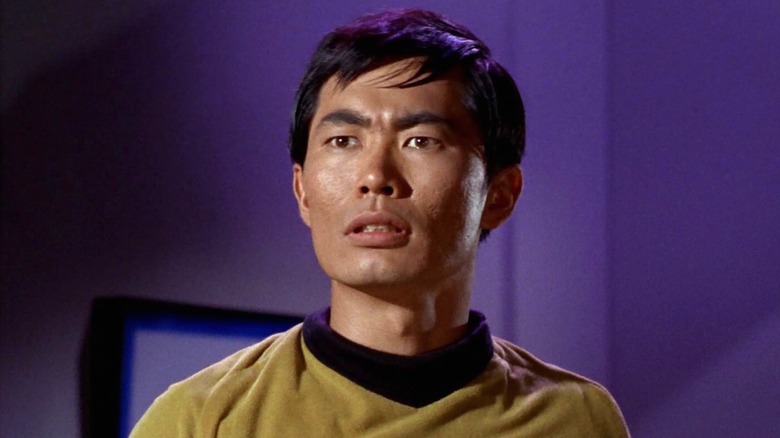
In one case that can be confirmed, a "Star Trek" script had to be altered for a very, very dumb reason. In a 1996 issue of Cinemafantastique Magazine, "Star Trek" actor George Takei, who played Lieutenant Hikaru Sulu, recalled overhearing Roddenberry gripe about the word "camel" appearing in a script. Takei doesn't recall the episode in question, but does know that NBC wanted the word "camel" removed ... because the network felt that it would evoke Camel cigarettes, a brand that did not sponsor their show.
Star Trek wasn't allowed to use the word 'camel'
Paramount
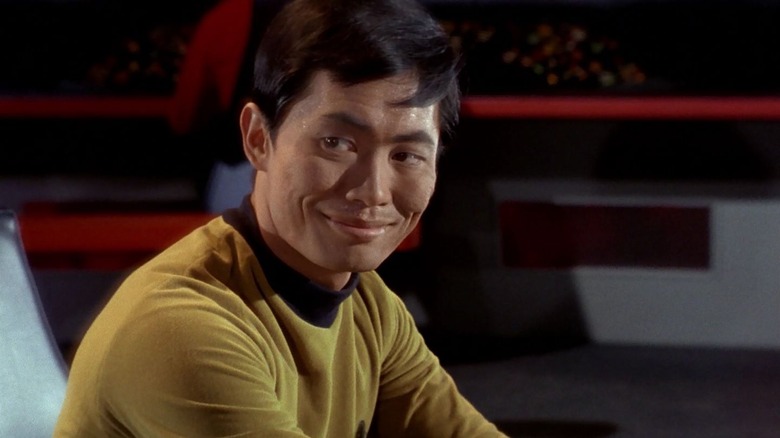
As George Takei recalled it, the network executives were notably persnickety, and were especially sensitive to offending their sponsors. When "Star Trek" creator Gene Roddenberry received a note from the higher-ups about one of his scripts, he had a hearty — and incredulous — chuckle. In Takei's exact words:
"There were commentaries that came from Broadcast Standards. I remember Gene raving about it, and chuckling about it too, both at the same time. He had worked in the word 'camel' someplace in the script, and apparently in those days, there were still cigarette ads being taken on television. There was a competing cigarette company that was advertising, so we couldn't use the word 'camel.'"
It seems that Roddenberry followed the note, and the word never appeared in the episode. Of course, because "Star Trek" was a sci-fi show set in the 23rd century, no one was seen smoking cigarettes anyway. There may have been cigarettes in the future, but the show was also set on board a tightly run military vessel, and no one would be allowed to smoke on the job. No one thinks about cigarettes when watching "Star Trek." It was the silliest possible note. But sponsors are sponsors, and "Star Trek" is part of the NBC family, so they toed the line.
A brief history of cigarette commercials on TV
Paramount
According to the Open Culture website, the last cigarette commercial to ever air on American TV was for Virginia Slims, and it was broadcast on January 2, 1971, at 11:59 p.m., during "The Tonight Show Starring Johnny Carson." Richard Nixon (of all people) had signed the Public Health Smoking Act in 1969, which banned cigarette companies from advertising on television. Prior to that, cigarettes were hawked by the Flintstones, and cigarette companies had their own slogans and jingles. Some readers may recall what "L.S./M.F.T." stands for — it was the slogan for Lucky Strike cigarettes: Lucky Strike Means Fine Tobacco." Some may be able to sing the tune to another jingle: "Winston tastes good like a cigarette should." Even something as family friendly as "I Love Lucy" was sponsored by Philip Morris.
After that act went into effect, that was it for cigarette ads on TV. "Star Trek" only broadcast from 1966 to 1969 in its initial run, so the idea of censoring the word "camel" was about to be wholly irrelevant.
Of course, as all Americans know, cigarette ads continued to be produced by the score, only in print and on billboards, until they were eventually phased out. The anti-addiction organization Truth Initiative pointed out that cigarette ads weren't banned on the radio until 1986, and it wouldn't be until 1998 that ads would be taken off of mass transit and billboards. Who remembers the controversy over Joe Camel, a kid-friendly cartoon camel that was seemingly used to hawk cigarettes to kids?
It's wild to think that "Star Trek" was tied up in all this advertising mishmash, even if it was only tangentially. But that's the way advertising works. It creeps into the culture and saturates, and it sometimes takes years of concerted effort to end it.




 English (US) ·
  Indonesian (ID) ·