
 1 month ago
A24
This article contains massive spoilers for "Backrooms." If you haven't seen the film, turn back now!
To the uninitiated, Kane Parsons' "Backrooms" — both the new feature film and the popular, lore-filled web series — probably seems daunting, almost impenetrable. Fear not (well, at least not about that, anyway), for just as in the series and movie itself, there isn't any barrier to wandering into the "Backrooms." If there's a "right" way in, it involves calibrating one's sensibilities more than doing any background homework. The appeal of the entire franchise lies in Parsons being instrumental in forming a trend which is increasingly referred to as "liminal horror." It's a subgenre of horror which has grown out of internet-based trends such as the creepypasta movement, and generally concerns the familiar becoming uncanny in a menacing fashion. Other recent films of this ilk, like "Skinamarink" and this year's "Exit 8" and "Undertone," tend to dabble in experimental, almost arthouse aesthetics in the way they deliver scares through creeping dread more than stabs and stings.
"Backrooms" is no exception to this, as Parsons and writer Will Soodik make the movie feel like an early '00s indie drama which slowly morphs into liminal horror as each character finds their way into the titular, seemingly endless space. Where Parsons' web series is almost exclusively experiential, largely made up of POV found footage, the film seeks to combine a character-based story with the series' signature languid ambiguity turned deadly immediacy (with some found footage sequences to boot). As such, its narrative isn't as direct as your average horror or sci-fi film. That's where I come in, hopefully. Think of me as your friendly local Async representative, giving you some answers on how "Backrooms" reaches its end, who's left standing, and what might come next around the corner.
How does Backrooms end, and who dies?
A24
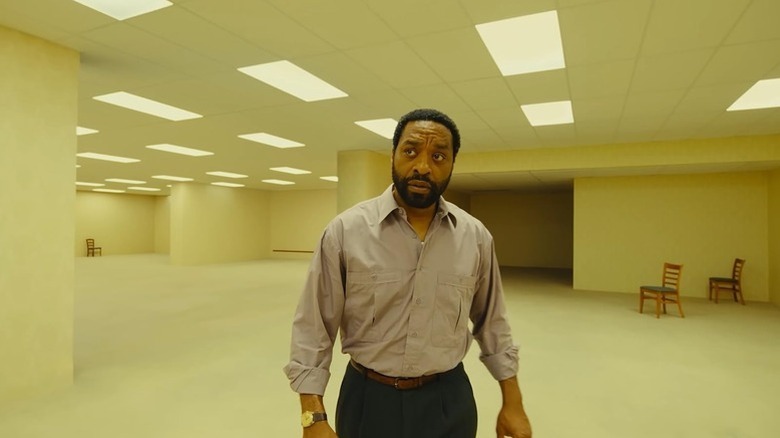
"Backrooms" is centered around Clark (Chiwetel Ejiofor) and Dr. Mary Kline (Renate Reinsve). Clark is a man twisted by years of disappointment and bitterness toward his failed career as an architect and his contentious (and abusive, as it's heavily implied) relationship with his ex-wife. Dr. Kline is his therapist, whom he seemingly chose in part due to her proprietary therapeutic technique, which promises the patient a newfound emotional freedom upon opening themselves up. When Clark goes missing after he talks about discovering a portal in the basement of his discount furniture store which connects to a bizarre dimensional realm, Mary is alarmed.
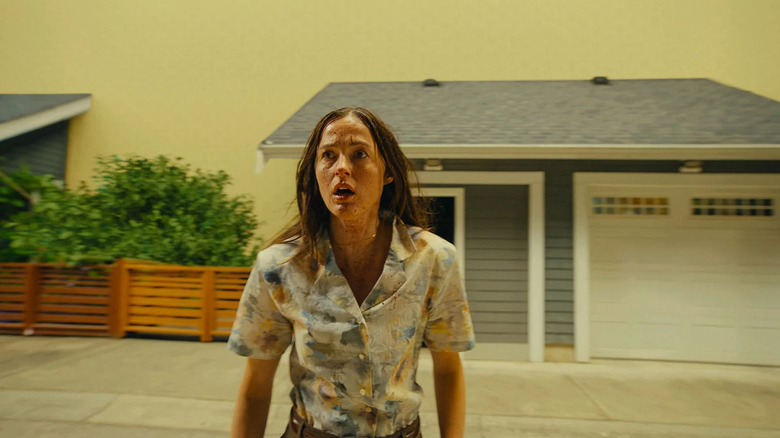
Mary then takes it upon herself to personally investigate, spurred on by her own troubled backstory. It seems Mary's mother suffered from mental illness and kept Mary and herself locked in their apartment during her childhood, which ended once her mother was taken away. Mary finds Clark now living in the Backrooms along with a few of its native denizens, copies of real world people that the realm created. The realm's version of Clark is his darkness made manifest: a tall, grotesque, violent monster dressed in Clark's despised "Captain Clark" store mascot costume. This monster murdered Clark's employees Bobby (Finn Bennett) and Kat (Lukita Maxwell), who were exploring the Backrooms with Clark when it attacked. Clark tries to reason with the monster, but it instead fatally bites him on the neck and comes after Mary. Mary manages to elude Captain Clark, only to fall into the clutches of representatives of the Async corporation, who study the Backrooms. As Phil (Mark Duplass), an Async rep, debriefs Mary, we fade to another area of the Backrooms which contains a mirror version of Mary childhood home and a mutated version of herself.
Does the ending of Backrooms set up a direct sequel? What happens to Dr. Mary Kline?
A24
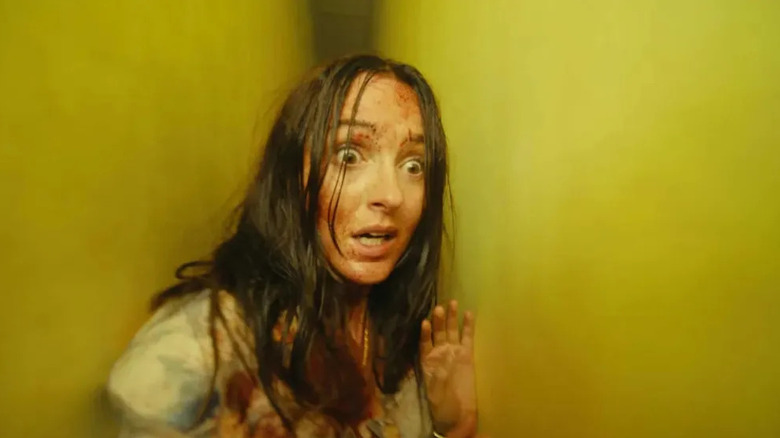
The end of "Backrooms" is up for much interpretation. While it seems at first glance that Mary makes it out of the Backrooms safely at the very least, even that is left up in the air, as we never explicitly see her travel through a portal back to the real world, and the Async facility she's in could be within the Backrooms itself. This ambiguity alone leaves the door open for Mary to return, with or without Phil (more on him later). Obviously, if Dr. Kline makes it back to the real world after having these experiences, it's possible neither she nor the powers that be may leave the topic alone for the rest of her life.
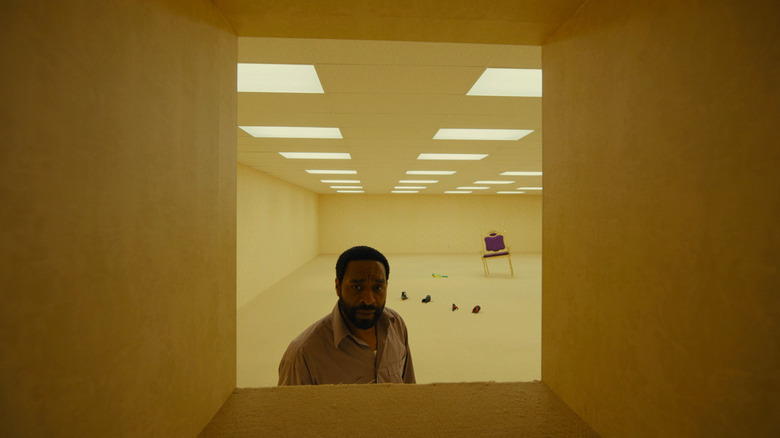
The film's haunting, eerie final montage, revealing recreations of locations we've seen earlier in the film and a facsimile of Mary in the Backrooms, is rife with promise. It's a manifestation similar to Clark's experience, and seems to imply that the Backrooms are, at least in part, a reflection and manifestation of people and objects in the real world. It's not yet entirely clear if the realm is inherently malevolent, but one could see the Backrooms as becoming someone's personal Hell, especially if they have unresolved or unexamined issues (which most of us do). Is that being in the final shot a monstrous version of Mary? Or is she simply her lost and lonely copy, as with the other Backrooms people we see? The film may be self-contained as a "Twilight Zone"-esque parable about Clark and Mary, but Mary could come back. In fact, so could Captain Clark, as we last see the monster's body (who perhaps isn't dead) being studied by Async scientists.
Will more Backrooms movies follow Phil and Async directly, or be an anthology?
A24
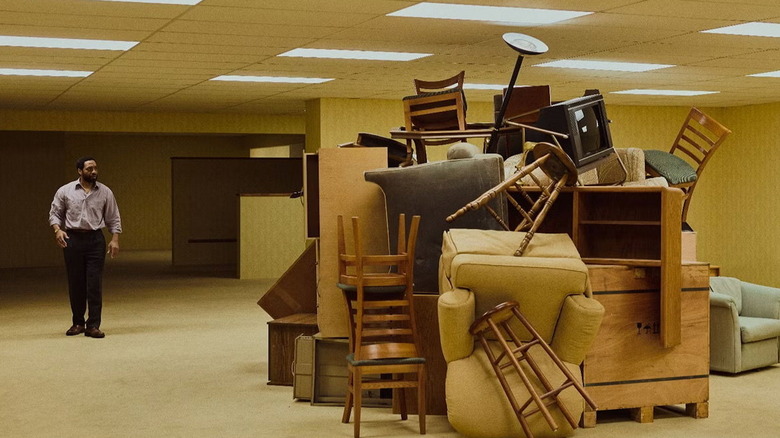
Like exploring the Backrooms themselves, a "Backrooms" sequel might choose to take an altogether different path than the direct continuation. As Kane Parsons has already established in his "Backrooms" web series, the Async corporation accidentally opened a door to the Backrooms in 1989, and this film takes place in 1990. While the movie shines a little more light on what Async is up to, there's still a lot of room to branch out and explore. After all, as Phil explains to Mary, the company only made MRI's until they accidentally discovered the Backrooms, so their existence as a clandestine scientific research company is fairly new and not entirely organized or locked down, as we see the death of an unfortunate employee in the film's opening sequence as well as Phil's unrelated, rather ordinary personal life.
So will a "Backrooms" sequel follow Phil as he investigates another person or persons who inadvertently find themselves in the Backrooms? It's entirely possible for "Backrooms" to adopt an anthology structure, and it could be the most creative way forward. However, the idea of a tight continuity of plot and character could be compelling when contrasted with the amorphous and mysterious Backrooms. Since Mary is, speaking archetypically, the Final Girl of "Backrooms," it would align the series more closely with horror movie history if she returned for another go-round. Perhaps it's possible to combine the two approaches, and have characters glide in and out of the narrative as easily as they step in and out of the Backrooms.
Does Backrooms even have an end (literally and figuratively)?
A24
All of this discussion about the end of "Backrooms" and the potential future of the series (which, if early box office indications prove correct, is all but guaranteed at this point) brings up an interesting contradiction at the core of discussing and analyzing the movie. As I keep saying, there's a great amount of ambiguity and mystery surrounding the film and its characters, which is a quality that Kane Parsons absolutely believes should be included. Thus, it's possible that the very idea of a clear end to "Backrooms" is antithetical to its premise. After all, the Backrooms appear to go on forever, even if the possibility of traversing through them becomes impossible. So, while the movie having an ambiguous finale isn't anything new by itself, perhaps its open-ended quality is the point.
"Backrooms" is liminal horror, but it's also existential horror, which is a bit of a bigger ask when it comes to a conclusion or continuation. In other words, its continual lack of resolution is the point, and any sequel could threaten the sanctity of that. However, Parsons has proven that his vision for "Backrooms" can weather the storm of the Hollywood machine and then some. Additionally, studio A24 has demonstrated their interest in protecting the artist and their vision first and foremost; the Philippou's "Talk to Me" sequel hasn't been fast-tracked to death, but has instead given the filmmakers time to develop it. Perhaps a "Backrooms" follow up won't be arriving swiftly, but if and when it does, it will likely give us a few more answers ... along with dozens of new questions.





 English (US) ·
  Indonesian (ID) ·