
 9 hours ago
Warner Bros. Pictures
This article contains spoilers for "Digger."
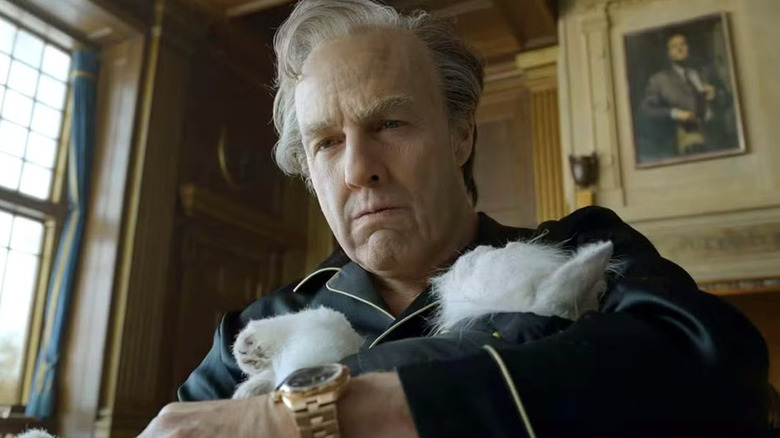
From the moment the first "Digger" trailer dropped, it was readily apparent that this film would be a departure for Tom Cruise. In Alejandro G. Iñárritu's new movie, Cruise initially appears to be playing Digger Rockwell, an octogenarian oil billionaire whose irresponsible drilling causes a massive environmental calamity that dooms the world. Given that Cruise has spent much of the last few decades portraying the god-like spy Ethan Hunt in the "Mission: Impossible" films, Digger, by comparison, seems like a wild 180-degree turn. When taking the whole of Cruise's filmography into account, however, he's not a complete wild card. Cruise has played odious villains before, as in "Collateral," "Magnolia," and (sort of) "The Mummy," and he's even played highly theatrical baddies, like Lestat in "Interview With the Vampire" and Les Grossman in "Tropic Thunder," both of which also required extensive prosthetic makeup. In this way, Digger isn't much of a stretch for Cruise.
What makes "Digger" truly unique amongst Cruise's cadre of characters is who he's actually playing. At the end of its first act, the film reveals that we're not watching a movie about Digger and the events of the crisis, per se, but are instead watching a stage play version of these events. The play is called "Fossil Fools," and we've been seeing a version of Digger as played by a fictional actor, Curtis Markson. This means that Cruise is playing Markson as Digger in addition to simply playing Markson, a man who's struggling to find the whereabouts of his daughter while backstage during final rehearsals. "DIgger," then, marks the first time that Cruise is expressly playing a character who shares his profession. It's a canny choice on both Cruise and Iñárritu's part, making "Digger" a fascinating metatext.
Tom Cruise saves the world as a version of himself in Digger

Warner Bros. Pictures
Nearly from the start of his career, Tom Cruise became synonymous with cinema. His dogged determination to squeeze every ounce of screen time for all it was worth helped make him a massive movie star by the end of the 1980s. Cruise has never rested on his laurels since, instead taking his projects (and, eventually, himself) to greater heights. As a result of all this, his screen persona generally became ultra heroic. Sure, he doesn't literally save the world in every one of his movies, but he does it enough times to make the rep stick. So, when Cruise portrays a villain or someone otherwise morally suspect, the film, by extension, is commenting on what it might look like if Cruise's stardom were corrupted.
"Digger" cleverly has it both ways. As DIgger Rockwell, Alejandro G. Iñárritu uses Cruise's charisma in service of unholy selfishness. In this manner, Digger is the anti-Ethan Hunt, a man who has just as much influence and determination but is working toward wholly selfish ends and, thus, destroying the world. Cruise then gets to play the flip side of this as Curtis, a popular and well-respected actor who is wracked with doubt about portraying Digger as well as the need for the satiric play itself. Yes, this is Iñárritu's way of trying to justify the existence of "Digger" within its own text. Yet, it's also Cruise wondering whether his work as an actor has value beyond entertainment. "Digger" doesn't provide any concrete answers, as Curtis' continuation of the play certainly doesn't save the world. Nevertheless, it seems to make a notable difference to those in the film's dystopian near-future, and for this movie, that's no small feat.
Digger sees Tom Cruise the actor reckon with Tom Cruise the movie star

Warner Bros. Pictures
As a celebrity, Tom Cruise has been remarkably tight-lipped about personal matters for decades, and that's for obvious reasons given his history. (As you might recall, his off-screen antics nearly derailed Steven Spielberg's "War of the Worlds.") Where the man seems to be expressing himself most deeply is in his work. I've written before about how the "Mission: Impossible" films are subtextually about acting and directing, and this sort of metatext can be seen in many other Cruise movies. For instance, in retrospect, "Top Gun: Maverick" mirrors Cruise almost single-handedly saving the day for Hollywood with the film.
Cruise has reckoned with his fame on-screen before, from Bill Harford in "Eyes Wide Shut" and Frank T.J. Mackey in "Magnolia" to Stacee Jaxx in "Rock of Ages." But "Digger" feels like Cruise evolving past those observations to tackle his legacy as Tom Cruise the actor versus Tom Cruise the movie star. The latter Cruise understands his appeal and preternatural ability to entertain, while the former seems unsure whether he's made a positive difference in the world when compared to the dystopia of "Digger," which is itself a thinly-veiled fictionalization of our current moment. Together, Cruise and Alejandro G. Iñárritu wonder if the arts can matter and survive in the face of overwhelming calamity. This is why Cruise is such a proper choice for his dual role: If anyone today can argue for the vitality of popular art, it's him. "Digger" may end up flopping, but it's going out on its own terms. One day, we may even regard it as a key work in the third act of Cruise's career. That is, if movies, theater, and the arts still exist then.
"Digger" is in theaters now.







 English (US) ·
  Indonesian (ID) ·