
 1 month ago
Paramount
We may receive a commission on purchases made from links.
Welcome to Trekspertise, a series where we break down the technology, history, details, and decisions that make the Star Trek universe so complex — and so fun.
When the creators of "Star Trek: Deep Space Nine" (which we once called the best "Trek" series) were creating the show, they kind of overfilled their plate.
For one thing, the series took place on the titular space station in a distant part of the galaxy that was fraught with drama. The station orbits the planet Bajor, which was, until very recently, militarily occupied by the evil, Nazi-like Cardassians. Deep Space Nine was built by the Cardassians, inherited by the Bajorans, but run and staffed by Starfleet, who are present to oversee and smooth over reconstruction efforts.
This would have been interesting enough a premise, but the showrunners also invented the notion that Deep Space Nine was also located right next to a newly discovered stable wormhole that led into the unexplored Gamma Quadrant, thousands of lightyears away. The showrunners spent almost the entire first two seasons of "Deep Space Nine" exploring the first part of their premise before finally getting to, in greater detail, what was in the Gamma Quadrant. It's eventually revealed that it's ruled by a vast, insidious dictatorship called the Dominion, and the Dominion is very keen to go through the wormhole and start merrily conquering stuff. Much of the second half of "Deep Space Nine" is devoted to the Dominion War with the Federation.
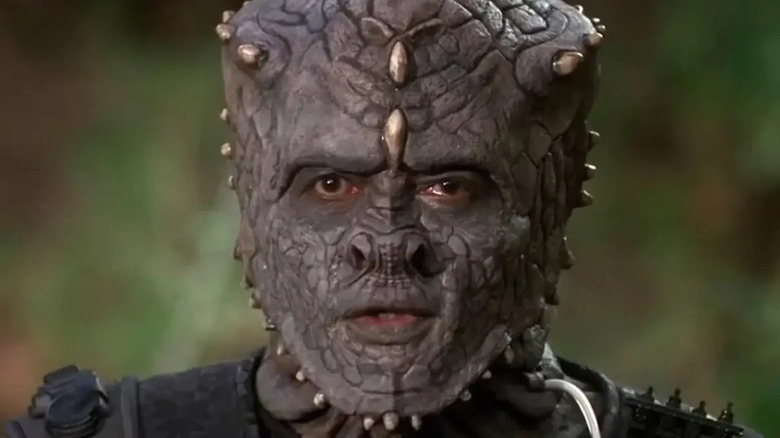
Like the Federation, the Dominion is a consortium of various alien species — only evil. They rule with an iron fist and have their own military infrastructure to enforce their draconian laws. Most notably, they have their own specialized fighting force in the form of the Jem'Hadar, a slave species of ultra-aggressive reptilian soldiers. The Jem'Hadar are 100% genetically engineered.
The Jem'Hadar are the drug-addicted military slaves of the Dominion
Paramount
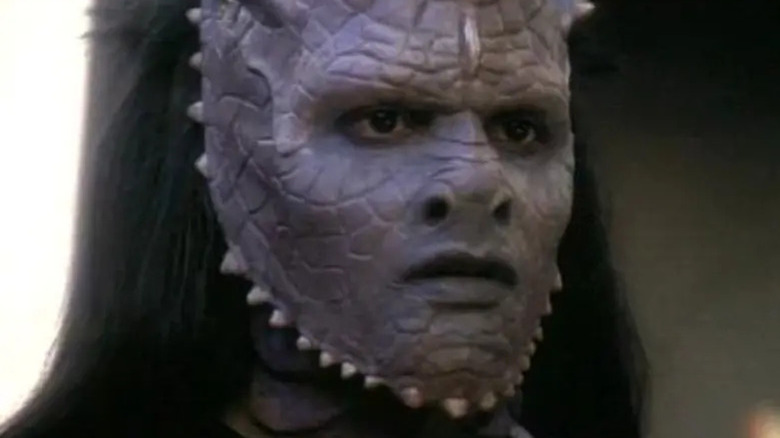
The Jem'Hadar were first introduced in the "Deep Space Nine" episode appropriately called "The Jem'Hadar." It was quickly established that Jem'Hadar soldiers are born out of specialized birthing chambers and emerge looking very much like human infants. Over the course of just three days, however, Jem'Hadar soldiers grow to maturity, and are able to fully function, having been genetically pre-programmed with language skills. Indeed, the genetic pre-programming of the Jem'Hadar is extensive. Their Dominion engineers infuse with them an undying loyalty to the cause, and the Jem'Hadar see their shape-shifting overlords, the Founders, as deities. They answered directly to a Dominion species called the Vorta.
Jem'Hadar soldiers are also very short-lived, dying before they can pass out of their physical prime. They only need to eat when they're adolescents, and they don't require sleep. The Jem'Hadar are also incapable of reproducing sexually and, as far as was seen on "Deep Space Nine," have no sex drive. All Jem'Hadar are bred to be male.
Most insidiously, the Jem'Hadar biological systems are engineered to be missing a specific isogenic enzyme. The Dominion provides the enzyme to the Jem'Hadar soliders in the form of a super-amphetamine called ketracel-white. Naturally, all soldiers are born with an unbeatable addiction to "the white," and they have to check in with their overlords to get their regular hit of the stuff. All of these details are meted out over the course of many episodes of "Deep Space Nine." In the invaluable "Deep Space Nine Companion," show writer Robert Hewitt Wolfe is quoted as saying that the more one learned about the Jem'Hadar, the less you would want to be around them.
They have no inner lives. They are built to serve.
The Jem'Hadar in the 32nd century
John Medland / Paramount+
At the end of "Star Trek: Deep Space Nine," the Dominion is overthrown, which likely means that the Jem'Hadar are left without a purpose. On "Star Trek," all life forms have value, so while it is not explicitly stated, one might safely assume that the Jem'Hadar receive help from Federation geneticists to break their addiction to ketracel-white and live longer lives.
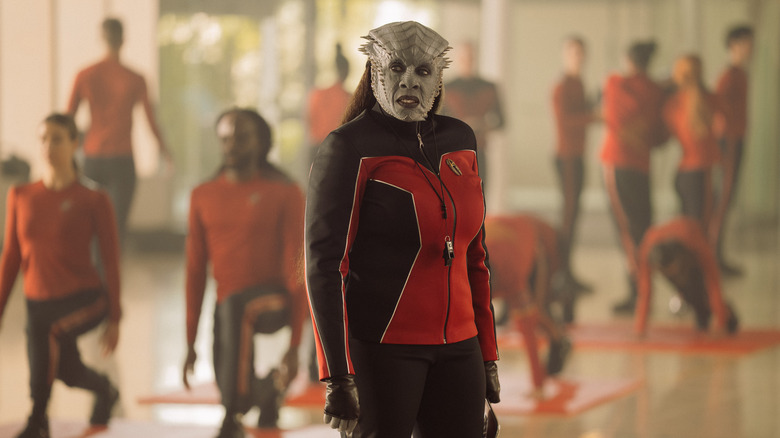
By the 32nd century, about 850 years after "Deep Space Nine," Trekkies learned that Jem'Hadar soldiers are able to reproduce sexually and that they became cultural allies with the Klingons, who share the Jem'Hadar's warrior ethos. This is all seen in the character of Lura Thok (Gina Yashere) on the YA-flavored "Star Trek: Starfleet Academy." Lura Thok is the First Officer on board the USS Athena, and an aggressive teacher of tactics and combat. She has a Klingon mother and a Jem'Hadar father, and notes that her father came from "the line of Kah-Baj," indicating that Jem'Hadar, over the course of over eight centuries, have developed carefully tracked lineages.
Although the Jem'Hadar did retain a great deal of their soldier-inflected past, Lura Thok noted that her father taught her the philosophy of "victory is life," a phrase the Jem'Hadar soldiers said to one another on "Deep Space Nine." She also noted that her maternal Klingon grandparents joined the Jem'Hadar on missions of conquest. That means that, timeline-wise, the Jem'Hadar seem to have developed the ability to reproduce and likely have females in their ranks by the 32nd century; they never stopped fighting.
Alternatively, in some non-canonical "Deep Space Nine" tie-in novels, it's implied that the Jem'Hadar eventually became more peaceful over time. I like that arc for the species better.








 English (US) ·
  Indonesian (ID) ·