
 4 months ago
Paramount
Welcome to Trekspertise, a series where we break down the technology, history, details, and decisions that make the Star Trek universe so complex — and so fun.
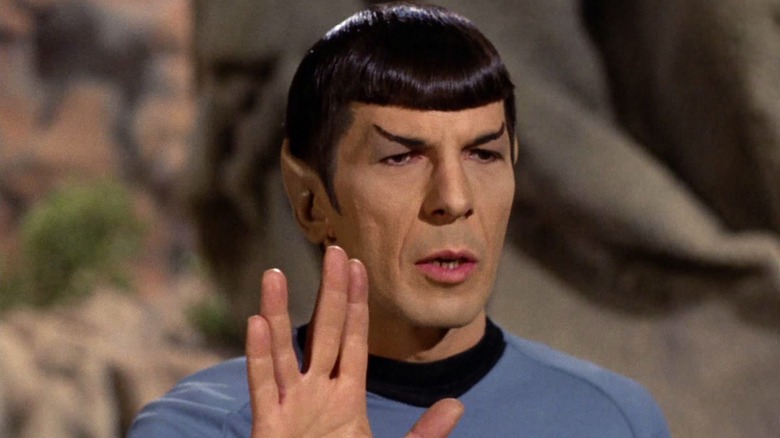
Back in 1966, when "Star Trek" was first airing, the character of Spock (Leonard Nimoy) captured the bulk of the public's attention. Spock, a half-human-half-Vulcan science officer, sported angled eyebrows and pointed ears, and always spoke in a calm, stentorian demeanor. As Spock explained many times on "Star Trek," the Vulcan species was devoted to a philosophy of pure logic, paired with an active attempt to rid themselves of all emotional impulses. Spock would sometimes have emotional outbursts, but for the most part he kept his cool. His emotionless demeanor was a perfect balance for the passionate responses of Dr. McCoy (DeForest Kelley) and the well-reasoned but instinctual command of Captain Kirk (William Shatner).
But Vulcans didn't always live this way. It was stated in early episodes like "Balance of Terror" and "Let That Be Your Last Battlefield" that Vulcans were once at least as violent as humans. Probably moreso, given that Vulcans, physiologically, are stronger and have more complex brains than humans. In episodes of "Enterprise" (set before the events of the original series), it was explained that Vulcans had become so violent and destructive enough that they began tipping toward nuclear self-annihilation. One can see a definite parallel between ancient Vulcan society and the development of the nuclear bomb here on Earth.
Luckily, a savior came by in the form of Surak, essentially the Vulcan Messiah. It was Surak that introduced the idea of emotionless logic as the basis for a society. This was, according to the "Star Trek: Enterprise" episode "The Forge," around the year AD 300 on Earth. Vulcans have been unified under logic for a long, long time.
Surak is essentially the Vulcan Messiah
Paramount
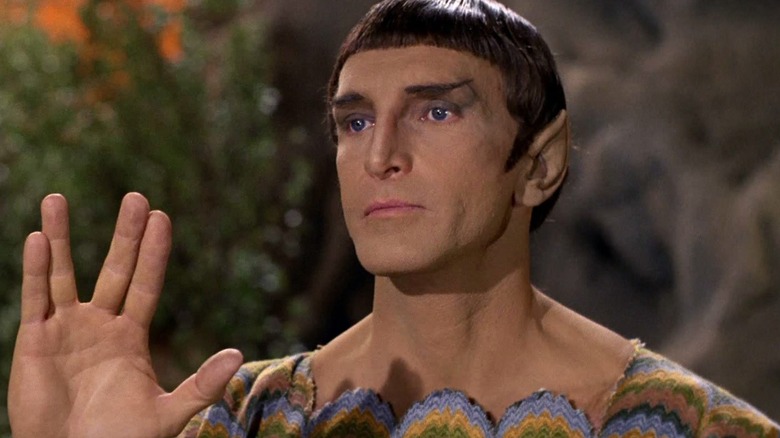
In the "Star Trek" episode "The Savage Curtain," Spock was allowed to meet Surak face-to-face (thanks to the psychic machinations of a species of living, molten rocks). Spock, upon seeing Surak, experienced a moment of genuine surprise, a moment he apologized for; it's unseemly to show emotions in front of Surak. Spock referred to him as "The greatest of all who ever lived on our planet ... The father of all we became." Surak is, in terms of his significance, a combination of Plato, Confucius, and Jesus Christ. His introduction of logic as a life philosophy ushered in a period in Vulcan history called the Time of Awakening.
Although a figure of logic, Surak also has mythic qualities. In "The Forge," he was said to have walked across a vast desert plain on Vulcan, and that his calm mind was so powerful, it physically cooled the deserts after the heat of a recent battle. That same episode noted that Surak died of radiation poisoning, contracted by a nuclear bomb.
Surak didn't flip the script for all Vulcans right away. In "The Savage Curtain," it was said that high-tech Vulcan wars continued to rage while Surak was actively trying to spread his message of peace and emotionless reason. Surak often sent pacifist emissaries to rival armies to negotiate, and the emissaries were mostly all killed. But Surak felt that it was logical to keep trying, and eventually, after many dead emissaries, opened up peace talks. After that, logic swept the planet. Logic = peace.
The most prominent emotion Trekkies see Vulcans express is impatience. But then, if you had to deal with smelly humans everyday (and our smelliness was mentioned as recently as "Star Trek: Strange New Worlds"), you'd get impatient too.
Vulcans still had taboos and secrets when they first met humans
Paramount
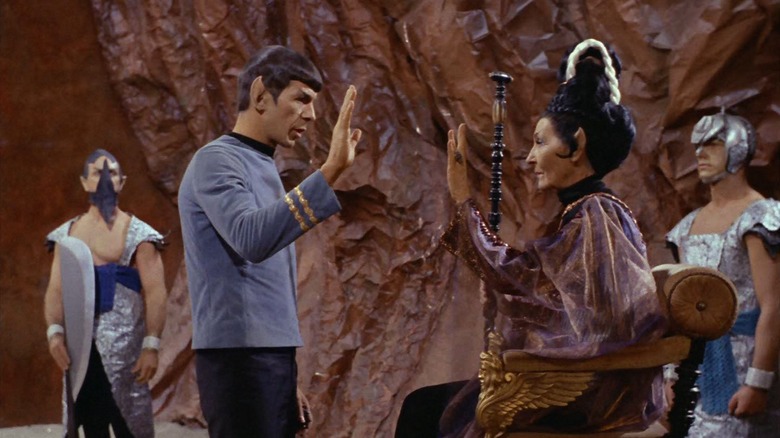
It should also be noted that Surak's efforts also led to splinter groups among the Vulcans, with some leaving the planet and settling on Romulus to form the villainous Romulan Star Empire. Others retained their passions and gathered into nomadic enclaves called the V'tosh Ka'tur.
And Vulcans, while devoted to logic, were also — many centuries later — prone to secrecy, war, and violence. Fans of "Star Trek: Enterprise" will be able to tell you about how mind-melds (invented because of CBS censorship) were once considered taboo in Vulcan society, and it was thought that only a secret minority could do them. Rather than logically welcome differences according to the Vulcan philosophy of Infinite Diversity in Infinite Combinations (or IDIC), the "melders" were forced to keep their abilities secret. This was all talked about in the "Enterprise" episode "Stigma."
And this was all in addition to secret military maneuvers against the Andorians and other war efforts. Although devoted to logic, Vulcans had, by the 2150s (when "Enterprise" takes place), retained an impulse toward war and tactics.
Weirdly, it was their exposure to the illogical, more violent humans that caused them to confront their errors and realign their society to be more accepting. Vulcans and humans, as explored throughout "Enterprise," have a tetchy relationship. Vulcans made first contact with humans in 2063, and helped Earth recover from a postwar period, aiding in the rebuilding of society. But at the same time, Vulcans discouraged humans from using their own warp engines to explore the galaxy; the first Starfleet mission didn't launch until 2151. Vulcans have the key to enlightenment and societal growth through emotionless logic, but they also have more growing up to do.




 English (US) ·
  Indonesian (ID) ·