
 5 months ago
A24
Which David Lowery do you know?
Do you know the David Lowery who makes surprisingly rich and heartfelt family movies, like the beloved "Pete's Dragon" remake, "Peter Pan and Wendy," and the animated "An Almost Christmas Story"? Or do you know the David Lowery who makes moody, frequently surreal, and often confrontational movies like "The Green Knight," "A Ghost Story," and "Ain't Them Bodies Saints"? His newest movie, "Mother Mary," falls into the latter camp so firmly that it should come as no surprise to see the A24 banner in the opening credits.
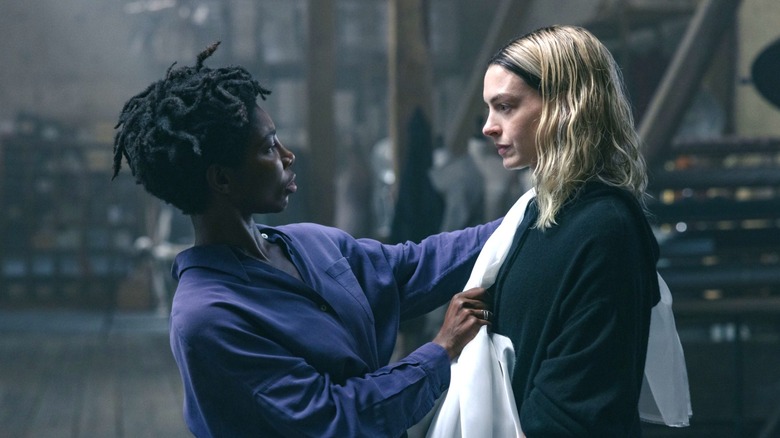
"Mother Mary" is the story of a world-famous pop star (Anne Hathaway) who visits her former friend and costume designer (Michaela Coel) with a major request, one that has startling (and potentially supernatural) strings attached. The film feels destined to create conversations among moviegoers as they puzzle through the film's many spinning pieces. This is a chamber piece about a broken friendship, an extravagant pop musical (complete with killer original songs), a creepy tale of ghostly possession, and, to hear Lowery himself describe it, a metaphor for his own artistic process. I loved it. /Film's critic did not. You should see it for yourself to make up your own mind.
I sat down with Lowery following an early screening of the film to discuss the movie's beautiful use of religious iconography, its earworm of a soundtrack, why he's happy his movies prove divisive, and whether or not there actually are two David Lowerys.
Note: This interview has been lightly edited for clarity and brevity.
David Lowery wanted religious iconography to lead the way in Mother Mary
A24
You clearly like Renaissance artwork.
Yes.
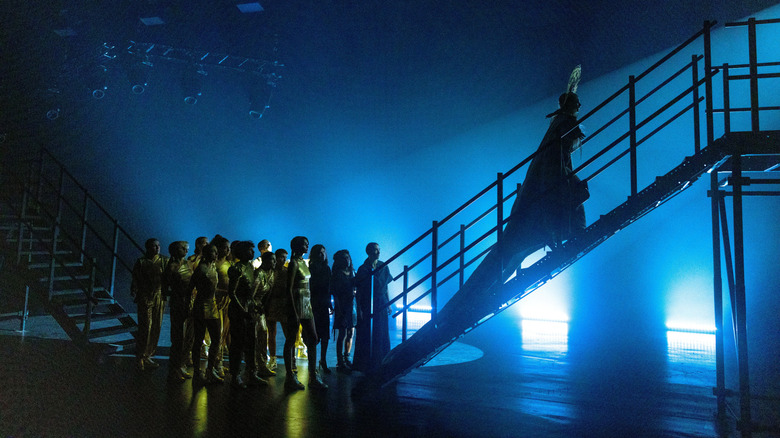
All the backstage stuff in the movie, it goes beyond the halo on Mary's head. It's how you stage tableaus around her. All of her background assistants or dancers standing around her, it feels very driven by that specific type of religious Renaissance art.
It was something that I'd already been leaning into in "The Green Knight," sometimes in the way we'd arrange people in the great hall or just creating these tableaus with the characters. We took that idea and ran headfirst into it with "Mother Mary." I really wanted the religious iconography to lead the way.
Were you always a fan of that, or was "Green Knight" sort of where you fully realized, "Oh, this art fascinates me"?
That was the first time that I felt ... sometimes you're pulling lighting references and you'll turn to Rembrandt or Vermeer, but that was the first time where I felt like my movies could directly participate in that visual language. But it was always a part of my life. I was raised in a very religious household. So the first time I went to Europe, my dad just took me all over Rome, all over Italy, looking at all of the greats in person. And we had books of all that artwork growing up. It was definitely an iconography that I was familiar with.
I saw "Mother Mary" with my art history major wife and we were talking about the Renaissance symbolism afterward, and I was trying to look smart, so I said, "Do you think there was some Dutch Baroque in the non-concert scenes?" So I now ask, is there a Dutch Baroque influence in the way the non-concert scene are shot and lit?
I wish I could sound smart and say yes. I could say that I went to see the big Vermeer exhibit in Amsterdam right before we started shooting, so maybe some of that seeped in there.
My wife said I was overthinking it, but I needed to double check.
Yes. [laughs]
All right. [laughs]
But I'd be making myself sound smarter than I am to say, "Yes, it was definitely a reference to this, quite literally," but it was in there.
I want to lean on the religious tableaus one more time, because even the way you've directed the extras, the facial expressions, the poses, they're very drawn from those elevated faces and gestures from that era of art.
Yes.
How do you direct that to your actors, to your team? Do you show paintings, or do you have it in your head and you try to just replicate it the best you can?
I would draw a lot of pictures for this one. And I'm not the best artist. I could just draw the shapes. And sometimes it would just be a matter of explaining to them how they fit into the frame and, "Here's where you're going to be. Here's how you are going to be standing. You need to land here at this point and make this gesture." There was a lot of physicality involved in the staging of these scenes.
Sometimes with big groups ... there's that scene backstage where she meets FKA Twigs for the first time and it's one take, lasts about three or four minutes, and we did it like 25 times to get all of those pieces to land consecutively in these perfect tableaus with all these moving pieces in them. And then in the barn with Michaela [Coel] and Annie [Hathaway] too, there was a lot of choreography involved in just standing, just standing and striking a certain pose. This was a movie that is riddled with poses. Everyone was constantly striking poses, and that was the language that I was trying to use to express things.
Mother Mary's writer/director had been wanting to make a pop star movie for a long time
A24
And you go back to the literal early definition of icon before we sort of brutalized it into what it is now.
Yes.
When we think of icon now, we think, "Oh, pop star," but icon means something so different in the artistic tradition of the word.
It comes from a Greek word, because I was looking it up recently for another project. This is the middle ground. I've got another project that's also dealing with religious icons, and I'm going to not be able to sound as smart as I'd like because I can't remember what ... but it comes from the Greek and it does reference ... We should look at it up together and learn this together in this moment.
We'll do it right now.
Yeah!
[Fumbling with phone] Let's see. Definition of icon.
The origin, yeah, the etymology.
[Still fumbling] Let's see ... Let's find ...
Econos or something is the word.
[Reads from Internet] "Eikṓn. In Eastern Orthodox Christianity, a representation of sacred events or especially of a sacred individual such as Jesus, Virgin Mary, or a saint, used as an object of veneration or a tool for instruction."
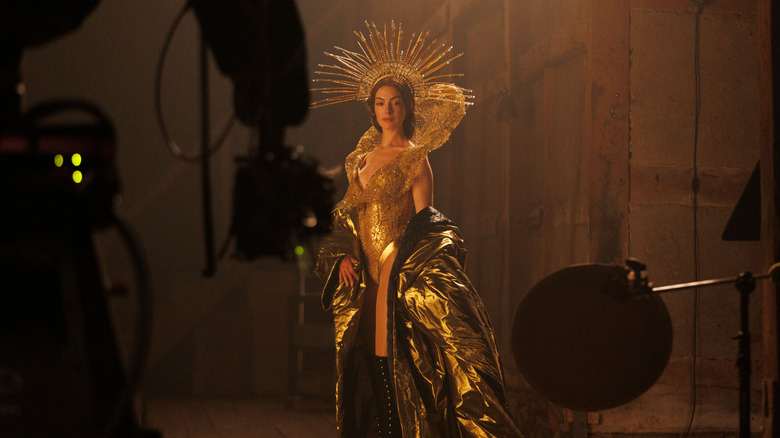
The object of veneration is very clear. It's the way in which those figures are even ... the poses they strike, it's meant to be genuflected in front of when you look at them. I also love the text that's inscribed in all those Eastern Orthodox icons, the symbols that are up in the corners, and that there's a ritual to not only the characters that are represented, but the context in which they're represented in those paintings. I love the gold leaf that they use to illuminate the halos, which was something that I tried to reference very directly in the crowns that the King and Queen wear in "The Green Knight."
Right.
And when I started writing this film on the set of "The Green Knight," I very quickly just grabbed those crowns and wrote them into the opening scene.
So what came first? Was it the idea of religious icons, or was the pop star on your brain already?
I had been wanting to make something [about] a pop star for a long time. That was a long-term goal of mine because I love pop music. The movie was born of something else. The movie was born of an internal dialogue, a conversation I was having with myself, about art and expression and all the things that are attached to being someone who expresses themselves for a living. And I very quickly knew that I did not want to make a movie about a filmmaker, but that I could take all of these questions about filmmaking that I had and transpose them into the world of pop superstardom.
Once I did that, it became something else. It ceased to be autobiographical. I started to invent characters rather than just purely rely on self-reflection, but it was a very immediate sense that this was the right direction to take the movie. It was the first night that I sat down to write it, I was like, as I'm writing this, it occurred to me, or I realized in a thunderstruck moment, "This is going to be my pop star movie."
How the Mother Mary team created convincing pop songs
A24
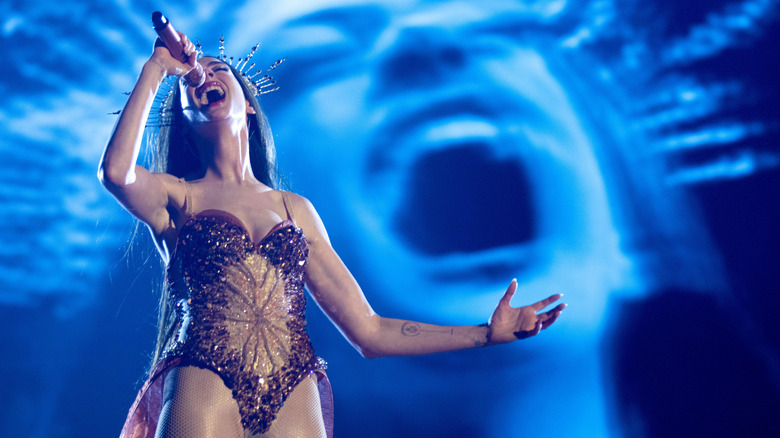
Mother Mary is a very convincing "fake" pop star. You watch the performances, hear those songs, and you go, "This sounds like a real artist." So what was the trick to making those songs actually feel like a real thing? I've already been listening to the released tracks since I saw the movie.
It was much harder than I expected it to be. I knew that it was possible, but I also knew that it was a tall order, because I've seen movies with fictional pop stars before that have great songs in them, but they don't stick the way the best of pop songs do for one reason or another. I think it required an entirely holistic approach. It had to work, not just for the movie, not just for the artists who were writing the songs, but for Annie, who had to perform them. I thought at first I could just give her five songs and she could sing them and we'd be done, but she very wisely explained to me that those songs need to be personal to her as an artist as well. They needed to be personal to Anne Hathaway, and to Mother Mary, and to David Lowery, and to [songwriters] Jack Antonoff and Charlie XCX.
That required a constant process of exploration and revision and trying to synthesize what it was that was important about this fictional artist. What she represented, not just to us, but to the culture that we were imagining she participated in. And none of these are things that you can just hit with a bullseye. You can't just throw a dart and nail it. It takes a lot of rinsing and repeating, or in Anne's case, a lot of going into the studio and recording the songs over and over and over again, adjusting lyrics, trying out different things until you finally find that alchemical synthesis that allows you to achieve whatever it is that great pop artists achieve that makes their songs so good.
I feel like we scratched the surface of it. Hearing you say that you would listen to these songs outside of the context of the movie makes me very happy, because we were trying so hard and we really were up against just like, "We have to finish the movie, we have to go to the mix. The songs have to be done now," but it was a real ... I wish we could just keep writing a Mother Mary album.
There's an old tradition of a certain type of Gothic horror story where two old friends meet in an old building and one shares a tale or supernatural terror and the other friend has to reckon with "Do I believe this?"
Oh yeah.
This feels like a modern update on something that would have been published in 1870. Did you draw from that tradition?
Yeah, definitely. I mean, I was very clearly — this isn't exactly that story, but I was really clearly drawing on "Rebecca" and [the book's famous opening line] "Last night I dreamt I went to Manderley again" is sort of like the mindset in which I imagined Mother Mary arriving at Sam's house. I wanted the house to feel like one of those classic English gothic, or one of the grand old manners that exists in those classic English gothic novels. I wanted to participate in that tradition, partially because I'm an anglophile, partially because I always referred to this as my goth movie. I know that being goth and the Gothic literary tradition are separate things, but there is an intersection I'm very keen on zeroing in on. And I also just love that vibe.
When we were shooting "The Green Knight," again, we were in these old barns in Ireland that we'd used to build our sets within. And I remember thinking like, "It's a shame we're building a set in here. This whole space is just so spectacular in and of itself. I wish I could set a movie here." So when I started writing this two-hander, again, much like I grabbed the crowns from "The Green Knight," I just grabbed that medieval barn from the English moors and decided that was going to be where Sam's workshop was.
So I told my co-workers that I've seen this movie and I was talking to you, and that started discussions about your work. It's funny to see people say "Oh, I love 'A Ghost Story,'" and then somebody else says, "That movie frustrates me so much." But then everybody at the same time says, "Oh, but we all think 'Pete's Dragon' is great." Does it delight you to hear that people are fighting but also uniting over your work?
I love it. It's great. It's also really makes me happy that everyone seems to agree about "Pete's Dragon," because for me, that movie is so ... it's so special to me. It's so personal to me, and it represents something, the further I get from it, a time in my life that was very transformative and where I was really coming into my own as a filmmaker. So to know that when I make a movie that is intentionally confrontational like "A Ghost Story" or intentionally divisive like "Mother Mary" will certainly be, I also love knowing that I'm capable of making something like "Pete's Dragon" that can unify. And that it's a safe place.
A lot of times I love being brave and being courageous with my movies and going out in uncharted territory, but sometimes I want to be just, I want a warm hug, and "Pete's Dragon" is that. I don't know if you saw the short film I did called "An Almost Christmas Story" that's also a Disney movie. It's one of my favorite things I've made and it's probably, at this point, the most widely seen thing I've made, and I love it so much because it does nothing but make people happy. And sometimes, that's all I want to do.
Are there two David Lowerys? The one who makes Disney movies and the one who makes "Mother Mary"?
They're the same person, but sometimes the distance between them grows further. Sometimes they grow further apart, and that distance and that tension between the two of them is what "Mother Mary" was born of.
David Lowery is always trying to distill his stories to their essence
A24
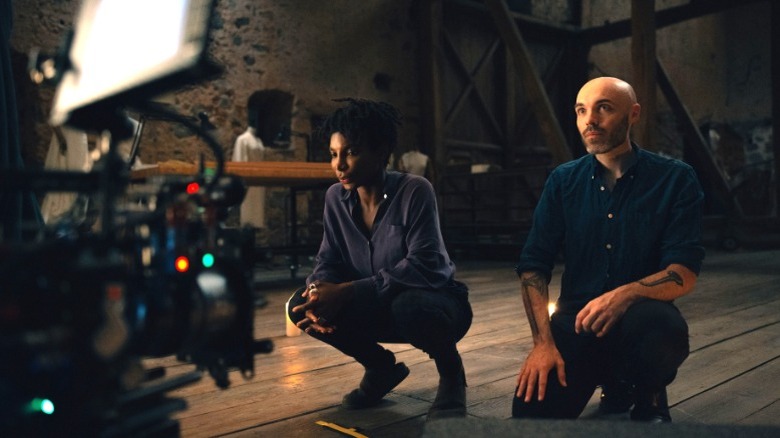
I was thinking about what sums up your movies, what unifies your work. I feel like all of your movies tend to anchor around a simple idea, a simple emotional truth, but you often take the audience through a labyrinth to get there.
I would say so because I'm always trying to get to the heart of something. I'm trying to distill something to its essence. But one of the things I'm always interested in distilling is iconography. I always want to get to the heart of an icon, and I think one of the unifying aspects of my movie, of my body of work, is that they're all centered around icons. Some more than others. I'd say maybe "Pete's Dragon" is the least of those, but everything else, it's the outlaw archetype. It is the knight on a quest archetype. It is the pop star archetype. And all of those archetypes are unified in their iconographic presence in our culture.
And I love taking iconography and these archetypes and peeling them away, peeling away the surface, peeling that paint, peeling that gold leaf away, and finding out what's underneath. Peter Pan is a great example. You think of Peter Pan, you think of the silhouette of a little boy in a window with his arms at his waist. And I was like, "We have to have that in the movie, but then we also have to understand what's broken within him." And that's not to say everything's broken. It's not all about trauma, but I really want to know the individual behind the archetype.
"The Green Knight" is my favorite of your movies –
Thank you.
– and both that and "Mother Mary" have a similar path where I'm watching, I'm thinking, saying to myself, "Okay, what's the movie trying to tell me? It's going down all these interesting avenues." And when you get to the final moments, you go, "Oh, it's actually about something that's really simple!"
Yes.
The journeys seem complex, but the finale is like, "Oh yeah, it was there all along."
It's true. I'm a very circuitous, in some ways, storyteller, but also that's very representative of life, probably. I have not lived the fullest extent of life yet, but I feel like when I look back on it, we take a long way towards getting to a very simple destination. It's a long, hard path. And when I'm making a movie, particularly when I'm editing a movie, I try out so many different things. I try every possible combination of scenes. I try removing things. I try cutting out all the dialogue. I try doing a silent version. And every version has its value, but then at the end of the day, you get to something that is pretty close to what you wrote. It's not too far from the script ever.
And I sometimes think to myself, "Couldn't I save myself some trouble by just editing the movie according to the script, just sticking to the script and just cutting that and being done with it?" But to really understand the movie I've made, I have to go down all of those random paths and blind alleys and circuitous, bramble-filled, dark forest paths. And I think it's a necessary part of the journey. So I suppose when I'm writing, I'm doing the same thing in some ways. I could just cut to the chase, but the chase wouldn't be worth it if I hadn't taken the long way around.
I'm glad you take the long way around.
Thank you.
"Mother Mary" is in theaters now.
 English (US) ·
  Indonesian (ID) ·