
 4 months ago
Pixar
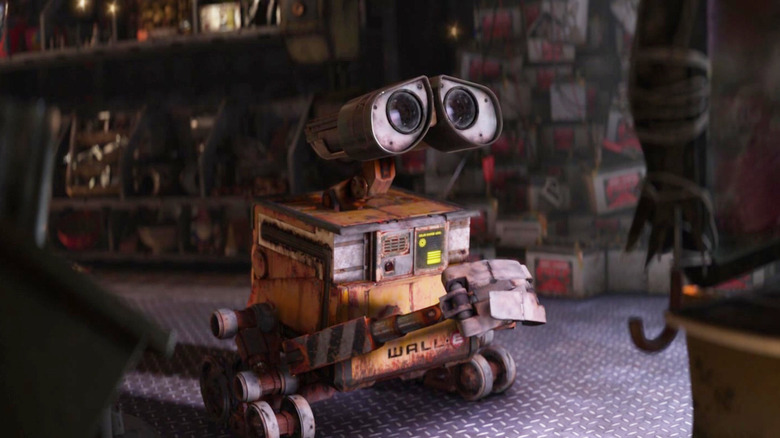
Director Andrew Stanton's animated 2008 sci-fi film "WALL-E" takes place in a distant future where Earth has been devastated by environmental disaster and overrun with garbage. Humans have all fled the planet. Seemingly, only cockroaches remain, so far as organic beings are concerned. The movie follows a semi-sentient robot, WALL-E, as he travels around the ruined landscape crushing mountains of garbage into tiny cubes. WALL-E has been at his job for a very long time.
A darker film might have gone in a different direction from there. In that version of the story, WALL-E would crush garbage, unaware that he's fulfilling a useless function. It would appear, then, that life is absurd and that our futile daily tasks are the only way we know how to give our lives meaning. Having made garbage his "thing," we must imagine WALL-E happy.
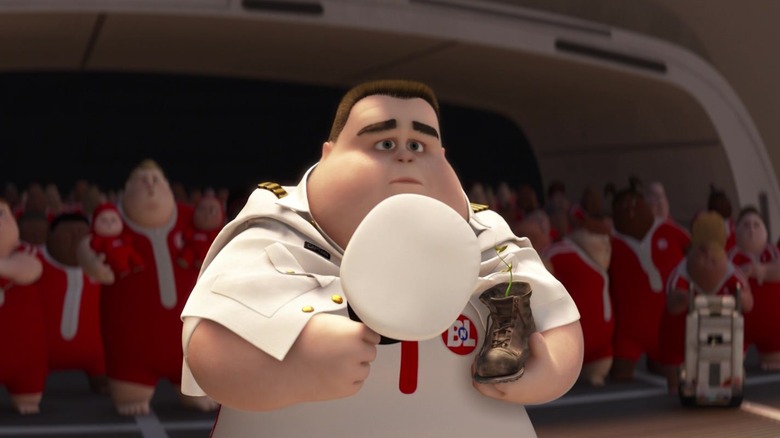
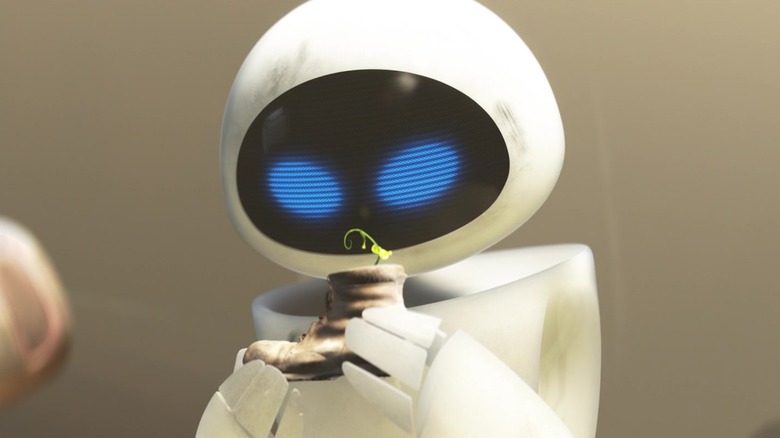
But that's not the "WALL-E" that so many folks love. Instead, the movie follows the titular robot as he hitches a ride on a visiting spacecraft (one carrying another robot, EVE, that he's developed feelings for) to a massive colony ship where Earth's survivors now reside. The ship is basically an endless mall, and humans have become so reliant on tech that even grown adults physically resemble giant babies now. But in spite of this dire situation, "WALL-E" ultimately ends on a positive note, albeit only after bringing its hero — and, in this case, humanity itself — to the brink of disaster.
An earlier iteration of "WALL-E," however, was a little edgier. Back in 2008 (per Newsarama), Stanton revealed that at one point, the story's humans had changed so much that they didn't even realize they were humans until the end. He likened this to the famous "Twilight Zone"-style twist ending of 1968's "Planet of the Apes."
An early version of WALL-E featured humans who didn't know they were humans anymore
Pixar
Andrew Stanton admitted that his initial ideas for "WALL-E" were inspired by the work of real-life NASA researcher John Hicks. It seems that Hicks was looking into long-term space flights and what would happen to a human body if it were left in zero gravity for a years-long period. Indeed, a round-trip Martian mission would take three years, so these are matters of grave importance. As Stanton recalled:
"[Hicks] told me [that] they still are arguing about how exactly to correctly set it up, so that when a human does go all the way to Mars and back, they won't start losing their bones. Because disuse atrophy kicks in if you don't simulate gravity just right the entire time. That's sort of a form of osteoporosis and you won't get that back. They actually said they've had arguments where they go, 'If we don't get this right, they're just going to be a big blob.' And I said, 'Oh my gosh, that's perfect! That's perfect!'"
Perfect? Because Stanton suddenly envisioned a version of humanity that had been in space for so long that their bones had atrophied from disuse, so much so they had become, essentially, living gelatin. As Stanton put it:
"To be honest, in a very early version, I actually went so weird; I made them like big blobs of Jell-o [...], because I thought Jell-o was funny and they would just sort of wiggle and stuff. There was sort of a 'Planet of the Apes' conceit where they didn't even know they were humans anymore, and they found that out. But it was so bizarre I had to pull back."
Speak for yourself, Mr. Stanton. I think full-blown gelatin people sound amazing.
English rocker Peter Gabriel ultimately unlocked the story for WALL-E
Pixar
To be fair, there is a precedent in sci-fi literature for gelatinous humans. Harlan Ellison's dystopian short story "I Have No Mouth and I Must Scream" ends with the narrator being transformed by a hateful, all-knowing computer into "a great, soft jelly thing." Had Andrew Stanton stuck by his guns, "WALL-E" would have evoked one of the scariest, weirdest stories ever written. Ultimately, though, the jelly-blob people weren't jibing for him.
Weirdly enough, it was Peter Gabriel — the famous English singer/songwriter behind beloved tunes such as "Sledgehammer," "In Your Eyes," and "Shock the Monkey" — that put Stanton on the right path. It was Gabriel who pointed out a certain evolutionary phenomenon that Stanton wasn't previously aware of:
"I thought, alright, I'll make them big babies. There's actually a scientific term that Peter Gabriel, actually, told me about. It's called neoteny. [It's] where there's this belief that nature kind of figures out that you don't have to use these parts of yourself anymore to survive, so why give it to you? Why let you grow any farther? And I thought that's perfect. It was almost again sort of a metaphor for 'It's time to get up and grow up!'"
So, the living gelatinous beings were replaced by infantilized humans. Stanton also included a fun conceit that implied that the humans in "WALL-E," an animated film, were once 100% photorealistic and only became big-eyed, cartoon-looking, round-bodied individuals after years of being away from Earth. It's not quite the same as Charlton Heston yelling "Damn you all to Hell!" in "Planet of the Apes" (nor is "The Simpsons" likely to do a "Wall-E" musical parody à la "Apes"), but it will have to do.



 English (US) ·
  Indonesian (ID) ·