
 13 hours ago

Paramount
Welcome to Trekspertise, a series where we break down the technology, history, details, and decisions that make the Star Trek universe so complex — and so fun.
On all the "Star Trek" shows, Starfleet captains are typically depicted as stalwart, capable, principled leaders, possessed of uncanny talents and ineffable insight that allows them to make important command decisions in an instant, often while under extreme pressure. Each captain has their unique command style, of course — Kirk is judicious yet passionate, Picard is measured and aloof, Sisko is angry and willing to flout rules, Janeway is caring and authoritarian — but they all wield their management duties with grace and aplomb.
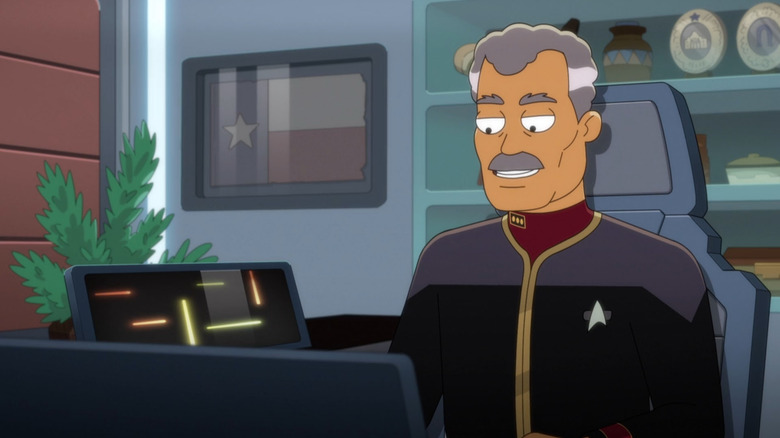
Starfleet admirals, however, are rarely as principled. In the world of "Star Trek," admirals are unscrupulous schemers who lurk around the offices of Starfleet Command, bitterly making unethical plans for major organizational overhauls. The examples of bad admirals are plentiful. One might think of Admiral Pressman (Terry O'Quinn) from "Star Trek: The Next Generation," who tried to develop illegal cloaking technology. Or Admiral Leyton (Robert Foxworth) from "Star Trek: Deep Space Nine," who faked evidence of a Changeling invasion so he could militarize Starfleet. One might remember Admiral Dougherty (Anthony Zerbe) from the studio-noted "Star Trek: Insurrection," who aimed to forcibly relocate the peaceful Ba'ku. More recently, one might recall the "Lower Decks" character Admiral Buenamigo (Carlos Alazraqui), who aimed to launch a fleet of A.I.-driven, weapons-hot drones into Starfleet to replace their starships.
Bad admirals are a widespread phenomenon on "Star Trek" to the point of becoming a cliche. Which leads one to ask: What happens to Starfleet captains that make them turn to the dark side once they get promoted? Why are so many admirals bad?
The short answer is: prestige. Allow me to elucidate.
Prestige is the only currency in Star Trek

Paramount
Bad admirals are such a well-recognized and widespread phenomenon on "Star Trek," even the official website has authored a handy-dandy guide so audiences can keep track. We're not blowing the lid off of anything by pointing this out. But something that has never been canonically addressed is why there are so many bad admirals in Starfleet.
It's worth recalling that "Star Trek" takes place in a post-capitalist utopia. Starfleet officers receive no paychecks, and are only compensated for their hard work with free room and board. More than that, though, they are rewarded for their tenacity with pride in a job well done. Starfleet officers all believe in the egalitarian, diplomatic ideals of Starfleet, and are wholly devoted to their field of study. Engineers love innovating with machines. Scientists love making new discoveries in the lab. If one can make a vital contribution to the forwarding of galactic society, then one can retire happy.
Captains can go to bed every night knowing they actively contributed to the advancement of Starfleet's ideals. Every day, they have to make command decisions that might alter the course of science, of diplomacy, and of the path of peace in the galaxy. It could be argued that Starfleet captains, who explore the final frontier in high-tech super-vessels, encountering new life and new civilization, have the most important, most prestigious job in the galaxy. They get to make the "big" discoveries, open channels of communication, and lead their crew on missions of mercy. If pride and prestige are the only currencies on "Star Trek," then captains are well-paid indeed.
Now imagine getting a promotion, moving off of a starship, and losing all of that. I'd wager that resentment would kick in pretty quickly.
Admirals turn bad because they can't contribute to society any longer
Paramount+
To remind readers, admirals don't command starships. Sometimes they oversee starbases, but often they're called in for cushy missions overseeing diplomats. One could argue that, after years of hard work and contributing to the galaxy as a captain, an admiral has earned the right to relax.
But how valuable is relaxation? After years of flying through time portals, quelling interplanetary conflicts, exploring the possibilities of consciousness, and fending off interlopers who might destroy the Federation, how satisfying can it be to lounge around and take care of a starbase? How much prestige can one really rack up once you're sitting at the top? One can easily see that admirals, missing their glory days as captains, might become idly ambitious during all their downtime.
As such, they begin hatching larger-than-life schemes to rewrite Starfleet entirely. I may not be able to contribute, they might think, but I will be lauded throughout history if I harvest life-saving eternal youth radiation from a distant planet. I only have to forcibly relocate one alien species. I am getting no prestige right now, as I am sitting around doing nothing but absorb resources, but I will receive a lot of prestige and honor if I introduce crewless attack drones into Starfleet, thereby saving endless lives.
If prestige is the only currency in "Star Trek," then idle, retired admirals, when left to their own devices, begin thinking only in "get rich quick schemes," as it were. In aching for prestige, they begin to lose sight of their ethics. Changing the galaxy becomes more important to them than doing the right thing. And if your "big changes" involve hurting a lot of people or lying, well, you've become a villain.







 English (US) ·
  Indonesian (ID) ·